

Gharpajhong Climate Change Conference Concludes with 21-Point Declaration Calling for Climate Justice

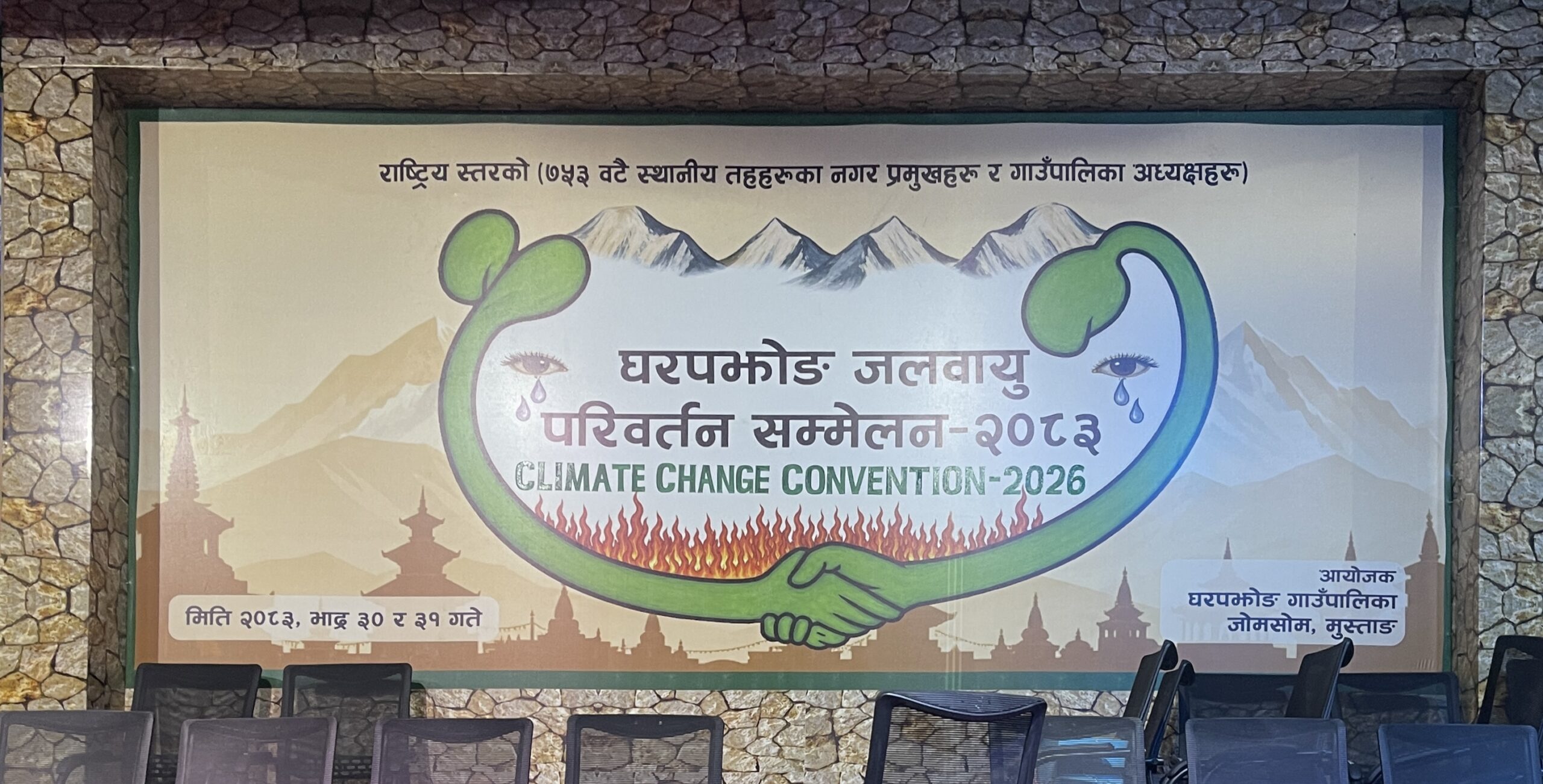

GANESH PAUDEL/JOMSOM, Mustang, September 16, 2026: The two-day Gharpajhong Climate Change Conference–2083 concluded in Jomsom, Mustang, on Wednesday with the adoption of a 21-point Gharpajhong Declaration on Climate Change, 2083, calling for climate justice, stronger climate action at the local level and increased national and international investment in the Himalayan region.
The declaration was issued on September 16, World Ozone Day, from Gharpajhong Rural Municipality of Mustang under the theme “The Voice of the Himalayas, Local Commitment and a Shared Commitment to Climate Justice”, with a broader message of “The Responsibility of Local Governments: Partnership for Climate Justice.”
विज्ञापन



Representatives of local governments from different parts of Nepal adopted the declaration as a common voice of local governments, emphasizing that Nepal is highly vulnerable to climate change despite having a very small contribution to global greenhouse gas emissions.
The declaration calls for climate change to be recognized not merely as an environmental issue but as a development and justice issue, with the protection of the Himalayas made a global priority.
It emphasizes that climate justice should be based on equity, fairness, common but differentiated responsibilities and responsibilities according to capacity. It also calls for the integration of local and traditional knowledge, nature-based cultural practices, community experiences, modern science, technology and innovation to build climate-resilient communities.
Scientific risk assessment and disaster preparedness
The local governments have committed to institutionalizing scientific assessments of climate and multi-hazard risks, geographic information systems, risk mapping and risk documentation in every local government.
The declaration calls for an updated geographic information-based information system through intergovernmental coordination and urges a shift from a disaster-response system focused on “rescue after disasters” to one based on risk reduction and anticipatory action before disasters occur.
It also calls for roads, bridges, drinking-water systems, irrigation facilities, schools, health institutions, tourism infrastructure and other public structures to be designed and constructed according to climate-resilient standards.
Local climate funds and transparent climate finance
The declaration calls for grant-based climate finance and the establishment of local climate funds that can be mobilized according to the risks, needs and capacities of local governments.
It also calls for climate-budget classification, tracking, public disclosure and results measurement at the federal, provincial and local levels to be made more systematic and transparent.
The participating local governments have further called for climate-related laws that clearly define the roles, responsibilities, resources and coordination mechanisms of the federal, provincial and local governments.
Recognition of loss and damage
The declaration gives particular emphasis to loss and damage caused by climate change.
It states that climate-related losses should not be limited to physical damage. Loss of life, culture, traditions, identity, forests, biodiversity, mental well-being, social relationships and other non-economic losses should also be recognized as integral components of loss and damage.
The declaration also calls for climate-induced displacement to be addressed through national policies and local action plans in an organized, safe, dignified and rights-based manner.
It emphasizes meaningful participation of women, Indigenous Peoples, Dalits, children, senior citizens, persons with disabilities, youth, farmers, pastoralists and other vulnerable communities in climate policies, plans, budgets and decision-making.
Local knowledge and climate opportunities
The conference recognized traditional and local knowledge accumulated through generations of coexistence with nature as an important foundation for climate adaptation.
The declaration calls for such knowledge and practices to be integrated with scientific knowledge and modern technology.
It also proposes collaboration with national and international scientific institutions to establish local climate information systems and calls for the establishment of a National Local Climate Knowledge Network to facilitate the exchange of technologies, good practices, experiences and lessons among local governments.
The declaration also views climate change as an opportunity for creating new employment and economic opportunities through the green economy, renewable energy, electric transportation, sustainable agriculture, nature-based tourism, waste management, energy efficiency and environmental services.
Call for stronger international action
The local governments have called on the UN Framework Convention on Climate Change (UNFCCC) and world political leaders to demonstrate stronger and immediate implementation-oriented commitment to the Paris Agreement goal of limiting global temperature rise to 1.5 degrees Celsius above pre-industrial levels.
The declaration calls for increased national and international investment in scientific research on climate change in the Himalayan region, glacier and glacial-lake monitoring and the expansion of early-warning systems.
It also urges Nepal to play a leading role in presenting the common concerns of Himalayan and mountain countries in international climate negotiations and calls for the early establishment of a transboundary information-sharing system on disasters.
The declaration further demands that the experiences, needs and rights of communities most affected by climate change be placed at the center of international climate finance and climate policy-making.
Risk-based division of responsibilities
The conference called for evidence-based disaster risk assessments and risk mapping across Nepal.
It proposes that areas identified as being at very high risk be addressed by the Government of Nepal, areas of medium risk by provincial governments and areas of lower risk by local governments, with the necessary legal arrangements, responsibilities and resources allocated accordingly.
Mustang’s riverbed management concern
The declaration has also highlighted a specific climate and disaster-risk concern in Mustang.
According to the declaration, the continued accumulation of sand, stones, gravel and other riverbed materials in the Kali Gandaki River and its tributaries has raised riverbeds in some areas to levels above nearby settlements.
This, it says, is increasing the risk of bridges being swept away and settlements and other infrastructure along riverbanks being damaged or destroyed.
The declaration therefore calls for necessary legal provisions, including amendments where required, to enable local governments to extract and manage riverbed materials from rivers and streams while taking into account environmental and disaster-risk safeguards.
Appeal to international climate funds over Bhotekoshi disaster
The declaration makes a specific appeal to the international community, developed countries and international climate-finance mechanisms, including the Green Climate Fund (GCF), Adaptation Fund, Fund for Responding to Loss and Damage (FRLD), Global Environment Facility (GEF) and Least Developed Countries Fund (LDCF).
It calls for compensation for the losses and damages caused by the catastrophic debris-laden flash flood that entered the Bhotekoshi River following the collapse of ice and rock/glacier material from Lamtang Lirung on Bhadra 10, 2083.
The declaration argues that such losses and damages should not be treated merely as matters of humanitarian relief or emergency assistance, but as issues of climate justice.
Commitments by local governments
As part of the declaration, Nepal’s local governments have committed to mainstreaming climate change and disaster risks into their policies, plans and budgets.
They have pledged to prioritize climate-resilient and risk-sensitive infrastructure, discourage the use of plastic materials in public institutions and gradually incorporate climate-related issues into local curricula.
Another major commitment is to establish a “Local Governments Climate Park” in Jomsom, Gharpajhong Rural Municipality, representing the shared identity and collective commitment of Nepal’s 753 local governments.
The declaration also presents a particular view of conservation, emphasizing the need to consider human existence, human presence, human sovereignty and scientifically informed human stewardship while developing conservation approaches. It states that conservation concepts that threaten human existence should progressively be rejected.
Conference to continue every two years
The declaration commits to continuing the climate conference every two years with the participation of local governments across Nepal.
In coordination with the federal and provincial governments, the Association of District Coordination Committees, Nepal Municipal Association and National Association of Rural Municipalities in Nepal are expected to play coordinating roles in ensuring the continuity of the conference.
“Save the Himalayas, save the climate”
Issuing the declaration from the banks of the sacred Kali Gandaki River, the holy land of Shaligram and under the blessings of Lord Muktinath, with the Nilgiri and Dhaulagiri mountains as witnesses, the participating local governments made a collective appeal to the global community:
“Save the Himalayas, save the climate;
Protect nature, protect the future of humanity.”
The declaration states that the fight against the climate crisis will be based on justice, equality, cooperation, science, local knowledge and collective responsibility.
It concludes with the message that stronger local governments are essential for stronger climate resilience, safe communities are essential for a safe nation, and protecting the Himalayas is essential for safeguarding the future of human civilization.
The Gharpajhong Declaration on Climate Change, 2083 was formally issued on Bhadra 31, 2083 (September 16, 2026) at Jomsom, Mustang, with the endorsement of Gharpajhong Rural Municipality and participating local governments of Nepal.




चर्चामा
सम्बन्धित समाचार












फेसबुक प्रतिक्रियाहरु