

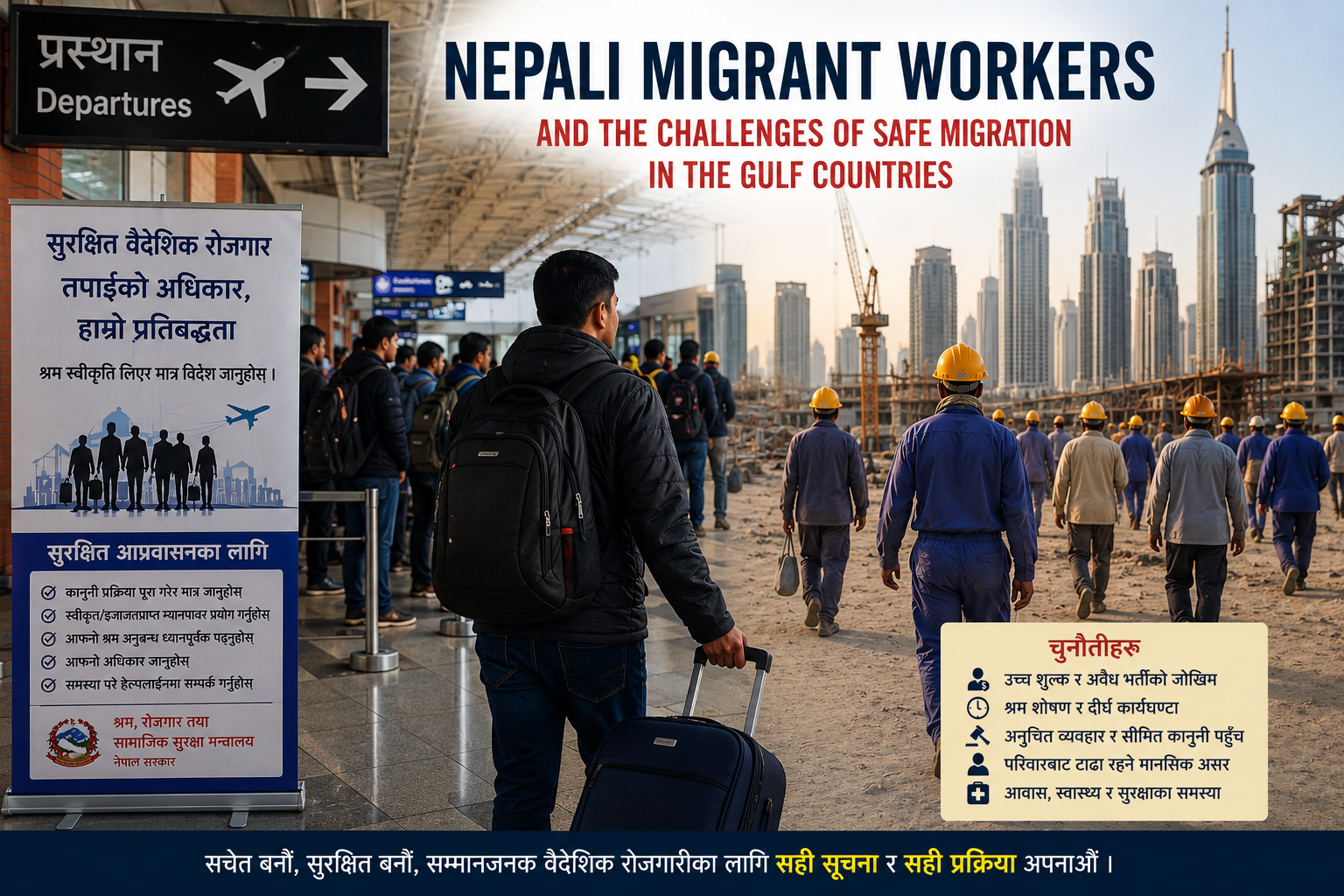
Nepali Migrant Workers and the Challenges of Safe Migration in the Gulf Countries



By Ganesh Paudel
PARBAT, Nepal — For thousands of Nepali families, foreign employment in the Gulf countries remains one of the few viable paths to financial stability. Yet behind the remittances that support households and the national economy lies a reality marked by recruitment costs, workplace risks, separation from families, and uncertainty over workers’ rights.
विज्ञापन



Jhalak BK, a resident of Kushma Municipality–12 in Parbat District who is currently employed in Qatar, says migration has helped him support his family but has also come with significant challenges.
“Working abroad has enabled me to earn an income that was difficult to secure at home. However, migrant workers often face long working hours, pressure to meet job targets, and the emotional burden of living away from their families,” BK said in an interview.
He believes prospective migrant workers should verify employment contracts, use licensed recruitment agencies, and attend pre-departure orientation before leaving Nepal.
For Shanta Paudel of Kushma Municipality–12, who has worked in Dubai for the past 16 years, migration has brought both opportunity and sacrifice.
“Foreign employment has allowed me to educate my children and improve my family’s living conditions. But the journey has not been easy. Many workers struggle with homesickness, cultural differences, and limited access to legal support when problems arise,” Paudel said.
Drawing on her experience, Paudel urged first-time migrant workers to understand their rights and responsibilities before signing employment contracts and to maintain regular contact with the Nepali embassy or consulate in their destination country.
According to migration experts, Nepal continues to send large numbers of workers to Gulf countries each year, where they are employed in construction, hospitality, domestic work, transportation, and other service sectors. Remittances from migrant workers remain a major contributor to Nepal’s economy, supporting household incomes and national development.
Despite the economic benefits, challenges persist. Workers may encounter contract substitution, delayed wages, unsafe working conditions, limited access to grievance mechanisms, and high recruitment costs. Women migrant workers can face additional vulnerabilities depending on their employment sector and destination.
Labour rights advocates say strengthening safe migration requires coordinated efforts by the Government of Nepal, destination-country authorities, recruitment agencies, employers, and civil society organizations. They recommend stricter regulation of recruitment practices, improved access to legal assistance, expanded financial literacy, and stronger bilateral labour agreements.
Both BK and Paudel agree that migration should be a matter of informed choice rather than desperation.
“Foreign employment can change lives for the better when workers are properly informed, protected, and treated with dignity,” BK said.
As Nepal continues to rely on labour migration, ensuring safe, fair, and rights-based migration remains essential to protecting the people whose work abroad supports families and contributes significantly to the country’s economy.





चर्चामा
सम्बन्धित समाचार




















फेसबुक प्रतिक्रियाहरु